
The Crossroads Issue 32
Anakin Skywalker and the Poetics of Tragedy
The Star Wars prequel is, at its core, a tragedy. Yet within popular discourse it has long been dismissed as pulp science fiction; a spectacle over substance sort of material.
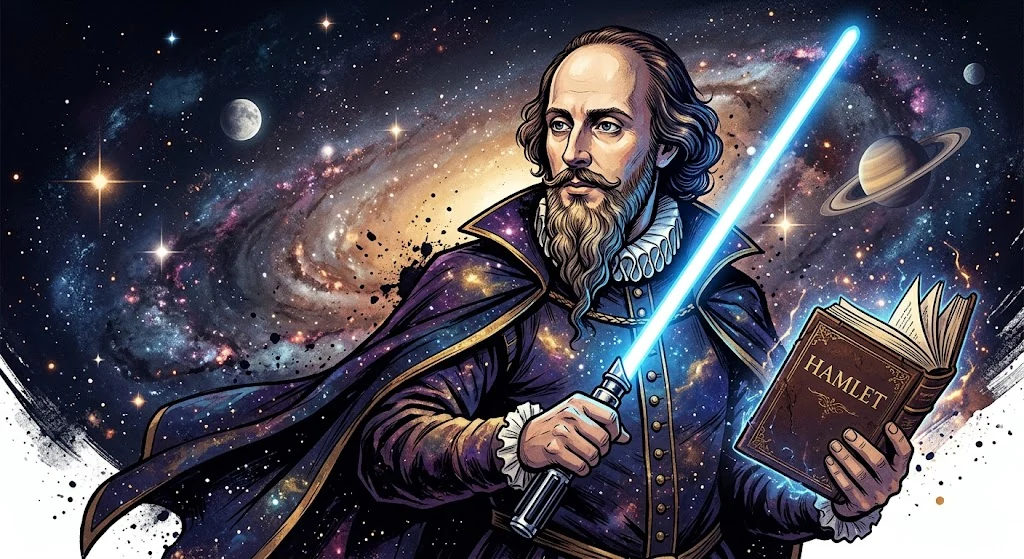
The Star Wars prequel is, at its core, a tragedy. Yet within popular discourse it has long been dismissed as pulp science fiction; a spectacle over substance sort of material. This article resists that dismissal. It reads Star Wars Episode III: Revenge of the Sith (2005), contrary to popular claim, not as blockbuster cinema, but as a literary text, and subjects its dialogue to the same scrutiny one might apply to Sophocles or Shakespeare.
The central claim lies in this: The dialogue in Revenge of the Sith (both Anakin's own speech and the exchanges constructed around him) functions as a deliberate literary mechanism that builds him into a recognizable tragic hero, one whose contours are shaped by the conventions Aristotle delineated in the Poetics and which recur across the tragic canon from Oedipus to Macbeth. The analysis is mainly modelled around four Aristotelian categories: Hamartia (The fatal flaw that initiates the flaw), Peripeteia (the reversal of fortune), Anagnorisis (the moment of recognition), and the cathartic effect produced in the audience through Eleos and Phobos (pity and fear).
Aristotle’s Hamartia works not as vice but as frailty, an imperfection indigenous to the hero’s own nature, not imposed on him from without. In Anakin, this frailty takes the shape of a love so absolute it cannot tolerate the ordinary erosions of mortality, wedded to a conviction that sufficient will can bend even fate to heel. The seed of this flaw is sown in Episode II: Attack of the Clones, in the aftermath of his mother’s death, when he confesses the massacre of the Tusken Raiders to Padmé, with fury, rather than grief or regret.
This fury resolves into 3 words that indict the greater picture rather than himself, or the cosmos, if I may: “it’s not fair.” Here, in embryonic form is the tragedy entirely: a boy who cannot reconcile himself to a universe indifferent to his longing.
By Revenge of The Sith, this same inability of reconciliation has fastened itself to Padmé. When Anakin confesses that he has seen her death, “As clearly as I see you now”, the line performs a double labor, it renders his devotion total, and it exposes his relationship with the future as one of conquest rather than surrender.
A Jedi is schooled in relinquishment, Anakin has never once relinquished anything, and his vow that he "won't let this one become true" is possession disguised in the vocabulary of love.
Hamartia — The Tyranny of Devotion
Aristotle’s Hamartia works not as vice but as frailty, an imperfection indigenous to the hero’s own nature, a not imposed on him from without. In Anakin, this frailty takes the shape of love so absolute it cannot tolerate the ordinary erosions of mortality, wedded to a conviction that sufficient will can bend even fate to heel.
Peripeteia — The Reversal Born of the Self
Aristotle held that the most devastating reversals are those the hero unknowingly manufactures himself. Anakin's Peripeteia arrives in the Chancellor's chambers, where he enters believing himself the exposer of treachery and departs its instrument. His plea to Mace Windu that Palpatine be tried, not executed, is in itself the hamartia made manifest in its purest form: the same desperate insistence that the universe yield to his terms rather than its own.
In striking down Windu, Anakin does not so much fall as continue, the gesture is not what most believe as rupture, but culmination, the tragic logic in which catastrophe emerges organically from character rather than intruding upon it. Every act that follows, the kneeling before his new master, the extinguishing of the Temple, unfolds with the merciless coherence tragedy demands, that which being, inevitability legible only in retrospect.
Anagnorisis — The Ash of Understanding
Anakin’s anagnorisis arrives as nothing but ash. On Mustafar, confronted by Padmé's horror, he answers with the knife of accusation, rather than clarity. Obi-Wan, he insists, has turned her against him, a sentence that reveals the absolute absence of knowledge, a man narrating his ruin as persecution. True recognition is delayed until he lies mutilated upon the volcanic shore, his voice dissolving into a scream directed at the man who defeated him. This too yet fails as wisdom, barely at its threshold, the first dim apprehension of an irony too exquisite to be coincidence: the vision he tortured himself to avert, he alone brought into being.
Catharsis — The Terror of Recognition
Aristotle believed tragedy should leave its witness trembling with Eleos and Phobos in equal measure; pity for the one who falls, and dread at the narrowness of the distance between his fall and one's own. It is this second current that popular memory has long declined to feel, for Anakin's flaw is neither exotic nor alien; it is love disfigured by the fear of its own impermanence, the seductive and universal delusion that longing, sufficiently fierce, might compel the world into submission.
Few who have felt this impulse become Vader. But the mechanical exhalation that closes the film, supplanting forever the voice that carried three pictures, is not the sound of a monster's birth. It is the sound of an entirely human hunger having consumed the vessel that once contained it, and it is in this recognition, rather than in spectacle, that the prequels finally earn the name they were so long denied: tragedy, in the oldest and most exacting sense of the word.