The Crossroads Issue 31
Is AI - Art Really Art?
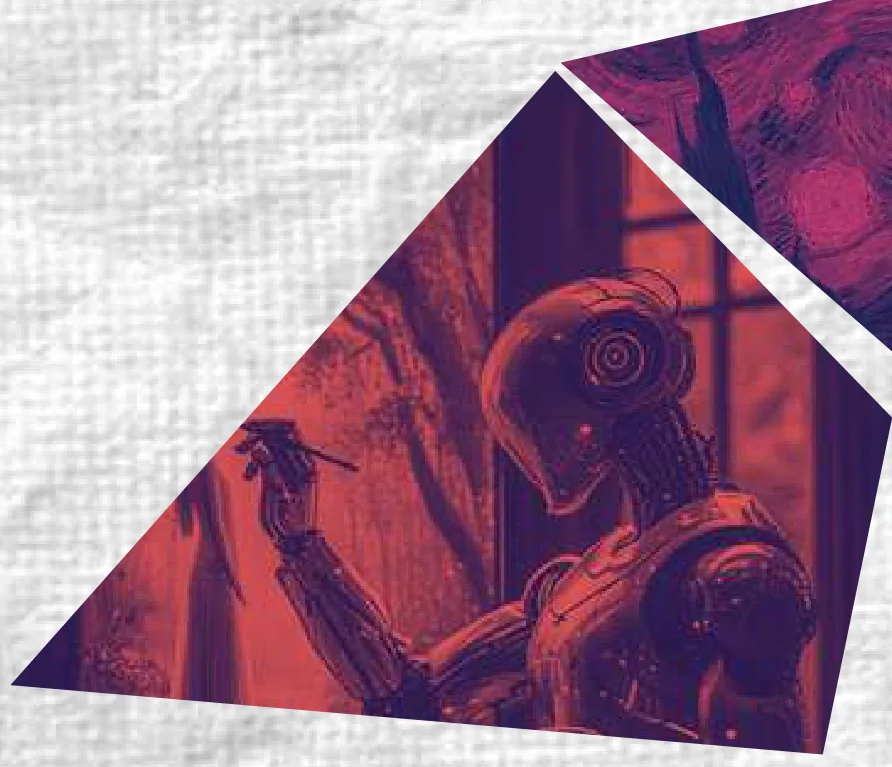
In today’s world, nearly everything we do has a trace of artificial intelligence in it, from our daily tasks to our school projects. Even solving a simple math problem leads to verification from AI. We have become habituated to using AI in even the smallest things possible, so much so that it has become an inseparable part of our lives. Not to forget some countries have AI bots as their ministers! AI has recently also invaded the sphere of art in , stealing jobs of several digital artists and content creators. According to a survey conducted by the Society of Authors, about 26% of freelance artists lost their income because of AI.
This intervention of AI in the domain of art raises a peculiar question - Is AIgenerated art really art? To answer this question we need to travel back in time to when traditional artists thrived. Art is considered the mirror of a society, defining the characteristics of the human species, serving as a universal language that has recorded human experiences, values, and emotions for tens of thousands of years. Throughout history, it has functioned not merely as decoration, but as a crucial tool for rituals, communication, social status, and historical documentation.
Even today art is valued at millions and is considered a symbol of status. An artist takes hours painting each stroke, constructing his painting with absolute precision, each painting carrying his emotions within it. Each painting whispers a thousand untold tales. But that is not the case anymore when we humans started using AI to generate art, we eradicated the very purpose of art. AI is a mere algorithm made to save our time and make our work efficient, but it has become so paradoxical that it started eating up the unique element that defined us humans for what we are - our mind.
Within a decade, we might not have the same crowd navigating to the galleries of the Louvre to admire the mastery of the Mona Lisa as we lose this beautiful bond between a human and a brush. Our appreciation for true human art has reduced as we’ve start shifting to more AIgenerated, lifeless art forms. The coming generations might not even know what Tanjore painting is! We are letting algorithmic efficiency take over the beauty of authentic human expression. This is a clear sign of our humanity itself deteriorating.
Unlike an artist who creates from his own lived experiences, from joy, sadness, anger, AI generates mirrors of existing patterns and data. It doesn’t have the same emotional attachment to the shallow art it makes. Art becomes beautiful when it has the human touch of imperfection, not when AI simply converts ‘art’ into a simple program that places pixels in the right way to make a ‘perfect’ version of the image. Let us make this clear - AI is a mere tool that should assist us with our day to day activities, we must not allow it to become a thief that robs our jobs, and more importantly, our thinking. Art without its human touch, ceases to be art.